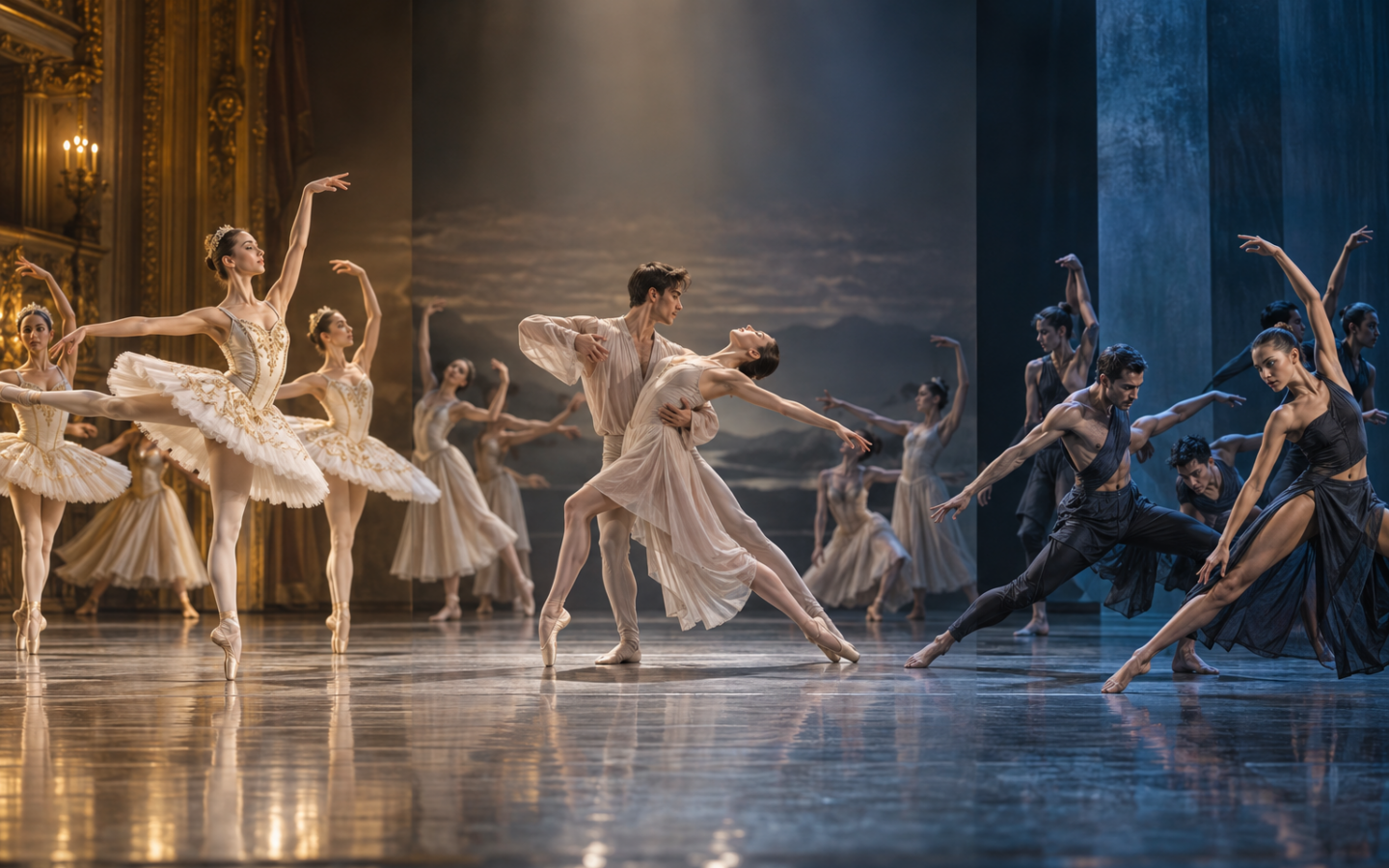
Can the same company move from classical order to neoclassical intimacy and end in a contemporary outburst without the night feeling like a catalogue? AIÓN answers by bringing together three choreographies separated by more than a century and turning their differences into a reflection on time.
The Compañía Nacional de Danza, directed by Muriel Romero, presents the programme at the Teatro de la Zarzuela from 23 October to 1 November. Past, present and future don’t appear as closed stages: they overlap in the bodies and show how a technique endures even when the language changes.
Paquita: precision, hierarchy and classical sparkle
The Grand pas classique from Paquita, associated with Marius Petipa and with a pas de trois by Petipa and Joseph Mazilier, places the company in front of academic clarity: lines, variations, ensemble and a technique that allows no distractions.
Petite Mort: six couples and Mozart
In Petite Mort, Jiří Kylián uses slow movements from two Mozart piano concertos. The piece shifts virtuosity towards relationship, touch, desire and fragility. It lasts barely fifteen minutes, but completely changes the temperature of the evening.
The Second Detail: the body accelerates
William Forsythe takes the vocabulary of ballet and pushes it off its axis. With music by Thom Willems, The Second Detail works with speed, imbalance and collective precision. It doesn’t destroy classical technique: it subjects it to another architecture.
The programme lasts approximately two hours with intervals. Performances are at 19:30 Tuesday to Saturday and at 18:00 on Sundays. The theatre’s dance tickets start at 16 euros.
Los pasos invisibles
The performances on 23, 24, 25, 30 and 31 October and 1 November include the free introductory activity Los pasos invisibles (The Invisible Steps): a half-hour tour to discover what happens behind the curtain and learn the keys to the programme with its performers.
Source and original details: see publication.